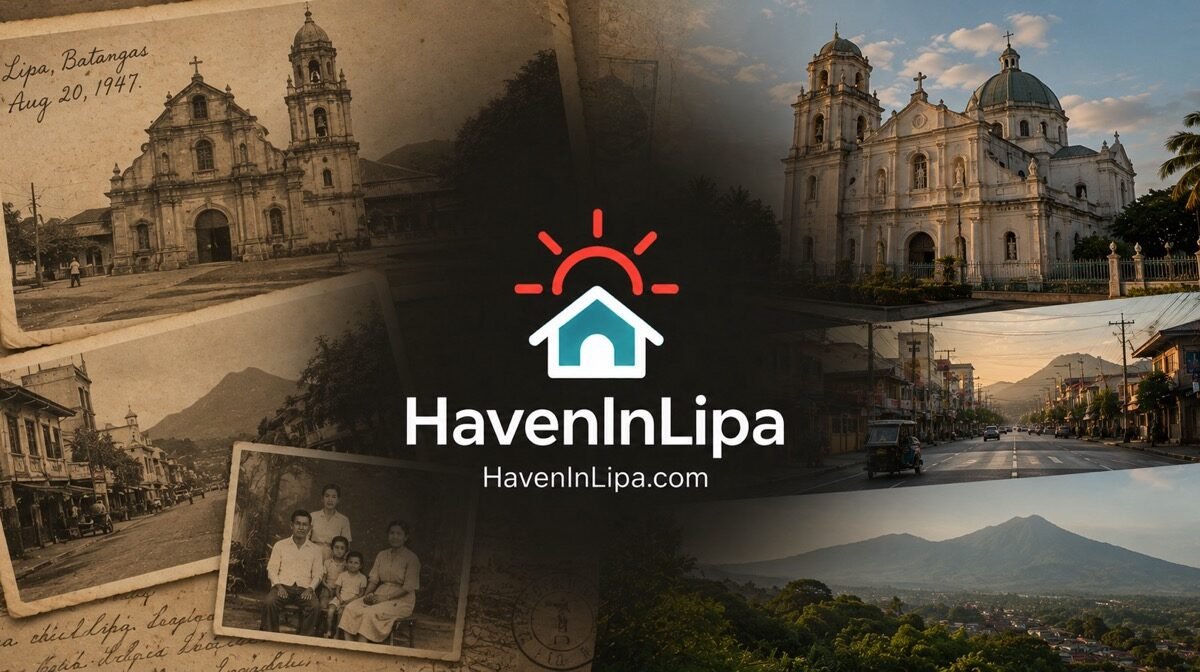
The day Lipa officially became a city
Two good fits for this trip
Mickey in Lipa | Family Staycation | Sleeps 7
From ₱2,500/night
Couples and small families
Cozy 1BR Haven | Solar Power•Netflix•Wi-Fi•5 Pax
From ₱1,500/night
Small groups (up to 5)
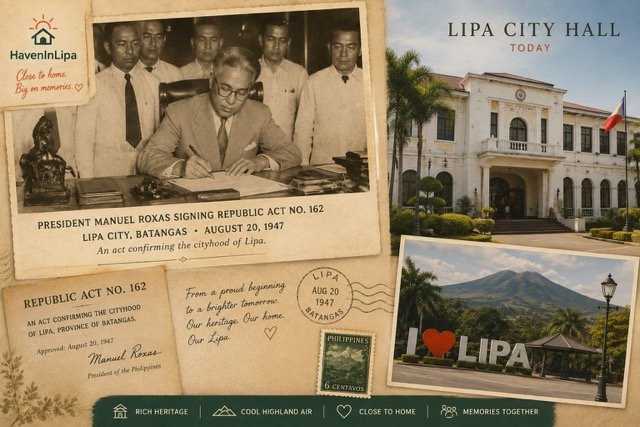
On August 20, 1947 — two years after the end of World War II — President Manuel Roxas signed Republic Act No. 162, formally elevating Lipa to a chartered city. The town that had once been the richest in the Philippines during the late-1800s coffee boom, that had survived the Spanish colonial era, the American period, the Japanese occupation, and a devastating wartime bombing — ultimately became, officially, the City of Lipa.
This is the story of that day, the centuries that led to it, and why a city that’s been a city for nearly 80 years, however, still feels — quietly, deliberately — like a town.
We celebrate Charter Day in Lipa every August 20. It’s not a major Philippine national holiday. It doesn’t shut the city down. But locals know the date, and the City Government, instead, hosts a flag-raising and a small civic program at City Hall to mark it. This article is for the travelers who want to understand the place they’re visiting — not just where to eat lomi.
🏡 Coming for Charter Day or a heritage weekend? Book direct with host Melody and save 15–20% vs Airbnb — no platform fees. Couples → the Cozy 1BR; families or a group → the Spacious 2BR (sleeps 9) or the Mickey in Lipa family houses (up to 15). Check availability ›
A short history of Lipa, told in four chapters
Chapter 1 — Pre-colonial and early Spanish era (pre-1700s to 1605)
The area that became Lipa was, before the Spanish, a community of indigenous Tagalog and Batangueño settlements organized around fertile volcanic land south of Taal Lake. Consequently, the volcanic eruptions and lahar flows of the original Taal Volcano (much larger and more active than the current cone) shaped the region for centuries – and ultimately drove settlements to higher, drier ground around what we now call Lipa.
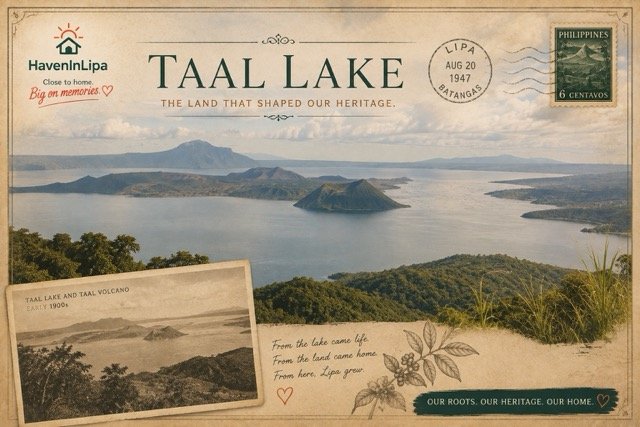
In 1605, the town was officially established as a Spanish-era pueblo. The early settlement was located closer to the original Taal Lake shoreline; subsequent eruptions and disasters pushed the community to relocate to higher ground, eventually settling at the present location of Lipa.
Chapter 2 — The coffee century (1700s to 1889)
The history of Lipa most travelers don’t know — and the period that explains the city’s character — is the long coffee century. Coffee arrived in Batangas in the 1700s. By the early 1800s, Lipa was growing it commercially. By the 1860s, Lipa was one of the world’s leading coffee suppliers, riding a global market disrupted by coffee leaf rust in Brazil, Ceylon, and Java.
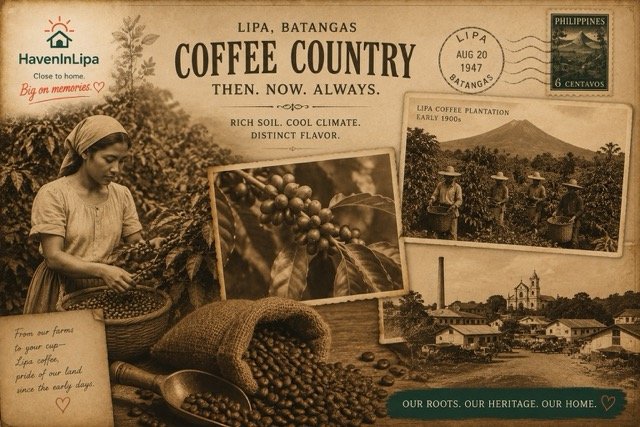
For roughly 30 years, Lipa was one of the wealthiest towns in the Philippines. Landowning families built bahay-na-bato mansions, sent their children to be educated in Europe, and gave Lipa a level of cultural sophistication unusual for a Batangueño town. This was the era of the Katigbak family – most notably the family of Segunda Katigbak, whose ancestral home is now preserved as Casa de Segunda, one of Lipa’s most important heritage sites.
In 1887, in recognition of its prosperity and importance, the Spanish colonial government granted Lipa the status of villa — a chartered town, the highest civic status below city. The full title bestowed was La Villa de Lipa.
Two years later, in 1889, coffee leaf rust arrived in the Philippines. Tragically within three to five years, Lipa’s plantations were largely destroyed. As a result, the export economy collapsed. Despite the ruin the town remained – the architecture stayed, the families stayed, the cathedral stayed — but the centuries-defining industry was gone.
For the deeper coffee history, see our Lipa barako coffee heritage guide.
Chapter 3 — American era and World War II (1898 to 1945)
The Philippine-American War and the subsequent American colonial period brought new administrative changes to Lipa. The town adapted — new public schools, new commercial structures, evolving civic identity. The early-American-era architecture overlaps with the Spanish-era heritage houses; some preserved buildings around the cathedral and plaza reflect both periods.
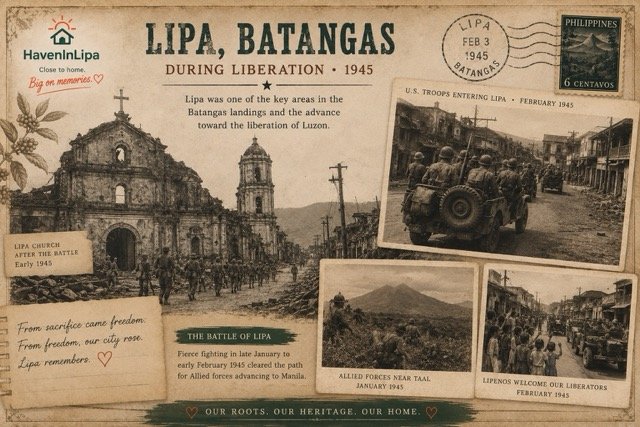
World War II changed Lipa permanently. Japanese occupation, followed by intense American liberation operations in the closing months of the war, brought widespread destruction. The Battle of Lipa in early 1945 caused significant civilian casualties and destroyed much of the urban fabric. Many heritage houses were burned or damaged. The cathedral and major buildings required rebuilding. The pre-war Lipa — coffee-era elegance, Spanish-era architecture, deep family roots — was substantially altered.
What survived in Lipa is what survived a deliberate, painful rebuilding. The city as it stands today is the result of that postwar generation choosing to keep what mattered.
Chapter 4 — Cityhood and modern Lipa (1947 to today)
Two years after the war ended, on August 20, 1947, President Manuel Roxas signed Republic Act No. 162 — the charter that elevated Lipa from a municipality to a chartered city. The decision recognized both Lipa’s historical importance and its postwar role as a regional center of southern Luzon.
Cityhood brought practical changes: independent city government structure, expanded administrative authority, formal civic identity. Over the following decades, Lipa grew — public works, schools (including the University of Batangas-Lipa and the De La Salle Lipa campus), hospitals, malls (SM City Lipa opened in 2003), commercial districts.
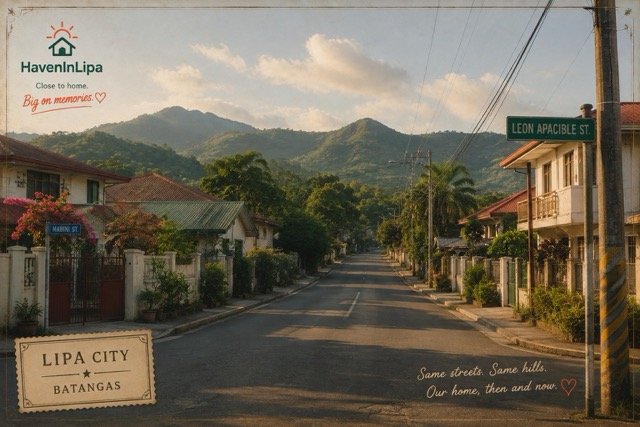
But Lipa never became a high-rise city. It never urbanized in the Metro Manila sense. The character of a town — quiet residential streets, family-run restaurants, slow afternoons — stayed. That’s the deliberate part. Lipa today is a city by charter and a town by feel, and locals consider this not a contradiction but a choice.
Why Lipa still feels like a town
A few specific things make Lipa feel un-citylike:
The pace. Saturday afternoons are slow. Restaurants don’t have lines around the block. The honk-and-dodge intensity of Metro Manila simply isn’t here.
The scale. Most buildings are 1 to 4 stories. Even SM City Lipa is a contained mall, not a vertical metropolis. The skyline is hills, not towers.
The family-run economy. Casa Marikit, Café de Lipa, Beegee’s Lomi House — Lipa’s most-loved establishments are family-owned, often spanning generations. Chain restaurants exist but don’t dominate.
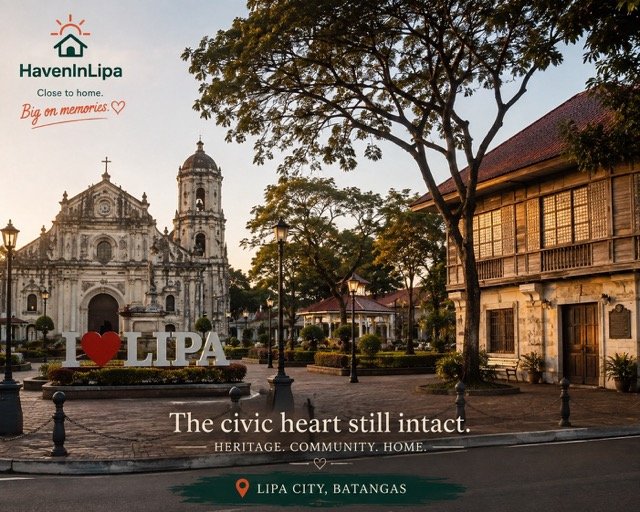
The cathedral and plaza still anchor the civic geography. Walk to San Sebastian Cathedral. Walk to Plaza Independencia. These remain the center, the way they were in 1850. New commercial districts cluster around the mall and the highway, but the old center still feels like the heart.
The people. Multi-generational Lipa families – the Katigbaks, the Calingasans, the Maglapuses, dozens of others – still live here. They know each other, they run the small businesses and they show up at the Charter Day flag-raising. That continuity is rare in a Philippine city.
The pride. Lipa locals are quietly proud of being from Lipa specifically — not just Batangas, not just southern Luzon. They’ll correct you. They have an identity built on a century of being a place that mattered.
How Charter Day is observed
August 20 in Lipa is not a national holiday. Most businesses operate normally. Schools may have a special program. The City Government hosts:
- Flag-raising ceremony at City Hall in the morning, typically 7:30 to 8:30 AM
- Civic program with speeches from the mayor, council members, and invited guests
- Wreath-laying at significant local memorials
- Sometimes a small parade or community event depending on the year
- Special Masses at San Sebastian Cathedral and other parishes
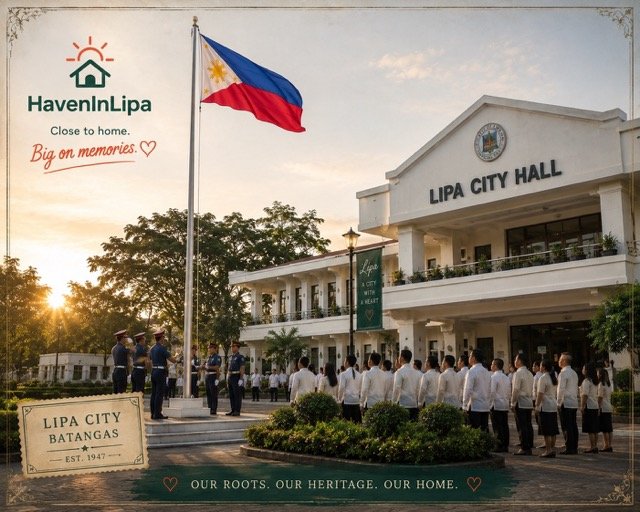
Travelers visiting on August 20 can attend the flag-raising at City Hall — it’s open to the public and a quietly meaningful way to mark the day. Visitors are not expected to participate beyond respectful presence. Wear modest clothing. Don’t take selfies during the formal ceremony.
The civic program is mostly in Tagalog with some English; if you don’t speak Tagalog, you’ll still understand the moment.
A Charter Day weekend in Lipa
For travelers who time their visit around Aug 20:
If Aug 20 falls on a weekday (like 2026 — Thursday):
Plan a long weekend Thu Aug 20 – Sun Aug 23.
- Thursday Aug 20: Arrive Lipa morning. Attend the City Hall flag-raising. Slow lunch at Casa Marikit. Visit Casa de Segunda or San Sebastian Cathedral. Quiet evening.
- Friday Aug 21 (Ninoy Aquino Day): Easier-pace day. Mt. Maculot hike or Taal Volcano day trip if motivated.
- Saturday Aug 22: Heritage walk, coffee at Café de Lipa, dinner out.
- Sunday Aug 23: Slow morning, depart by noon to beat traffic.
This is a particularly rich week: Charter Day Thursday + Ninoy Aquino Day Friday = back-to-back civic and national observances, in a city that takes both seriously.
See our August long-weekend booking guide for the full booking strategy.
If Aug 20 falls on a weekend:
It hasn’t in 2026, but in years when it does, the civic program may be scaled up. Check the City Government of Lipa Facebook page for the year’s schedule.
What to do on or around Charter Day
A few things that fit the day’s spirit:
Visit the cathedral and plaza early in the morning. The civic and religious heart of Lipa. 20 minutes of quiet observation tells you a lot about how the city sees itself.
Walk through the heritage zone. Casa de Segunda, the older streets around the cathedral, the preserved bahay-na-bato facades. The architecture is the visible record of Lipa’s 1800s prosperity. See our Casa de Segunda heritage walk guide.
Eat at family-owned, Lipa-rooted restaurants. Beegee’s, Casa Marikit, Café de Lipa. Skip the chain restaurants on this day. Eat where the city’s continuity lives.
Pick up a bag of barako coffee. Direct from Café de Lipa or the public market. The coffee history is what made the city — drinking a real Lipa barako on Charter Day is the most appropriate possible souvenir.
Talk to locals. Lipa shopkeepers, market vendors, and longtime restaurant staff often share stories if you ask politely. Ask about the family that founded the business. Ask about how the neighborhood has changed. The conversations are usually generous.
What the city is keeping and what it’s losing
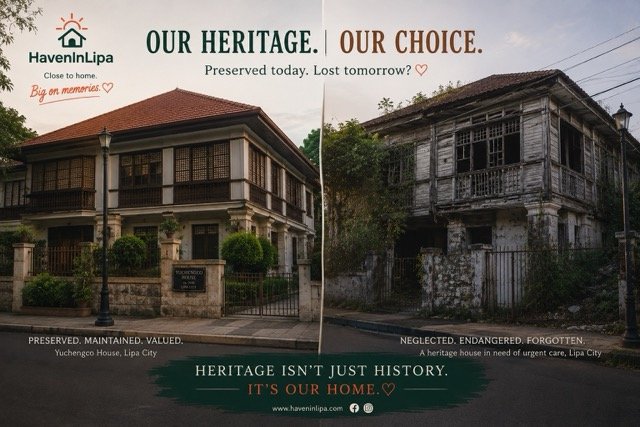
Lipa is in a real and unresolved tension between preservation and growth. The honest picture:
What it’s keeping:
- The slow pace, especially in residential neighborhoods
- The family-run restaurant culture
- The cathedral-plaza-heritage center as the civic heart
- The coffee identity (renewed by third-wave cafes)
- The food culture (lomi, barako, traditional Batangueño cuisine)
- The relationship with surrounding agriculture and small towns
What it’s losing:
- Some heritage houses (private, decaying, not being preserved)
- The original landowner-class population (younger generations relocating to Manila or abroad)
- Some traditional crafts and small-scale agriculture
- Quiet streets in the new commercial-development zones
What’s open to choice:
- Will Lipa scale toward more high-rise development, or stay low-rise?
- Will tourism become an economic driver, or stay incidental?
- Will the heritage-preservation movement grow, or stay small and scattered?
For travelers, these aren’t abstract questions. The Lipa you experience as a visitor today is the result of decades of decisions. The Lipa your kids will visit in 20 years depends on what the city chooses now.
We host in Lipa partly because we want to bet on the version of the city that keeps its character. Every guest who comes for the slow pace, eats at the heritage restaurants, and goes home telling friends about the quiet city is a vote for that future.
Common Charter Day questions
Is August 20 a public holiday?
Not a national holiday. Lipa City may declare it a special local non-working day in some years for city employees. Most businesses operate normally.
Can tourists attend the flag-raising at City Hall?
Yes. The ceremony is public and respectful presence is welcomed. Arrive 15 minutes before the scheduled time. Dress modestly.
Are there special restaurants or food events for Charter Day?
Sometimes. Café de Lipa or other heritage establishments occasionally run small Charter Day specials or commemorative menus. Check their social media around mid-August.
Is the city government open for tours?
City Hall is generally open during business hours. Formal tours aren’t a regular offering, but the public-facing portions of City Hall (lobby, civic spaces) are typically accessible.
What’s the difference between Charter Day and Foundation Day?
Some Philippine cities celebrate both — Foundation Day for the original Spanish-era founding (1605 in Lipa’s case) and Charter Day for cityhood (Aug 20, 1947). Most Lipa observances focus on Charter Day in August. Foundation Day, when observed, is more of a niche civic event.
Is this a good week to visit Lipa?
Yes — particularly with Ninoy Aquino Day immediately following on Aug 21. The civic richness of the back-to-back days is interesting for heritage-curious travelers. Book ahead.
Where to stay in Lipa
All direct-booking — save 15–20% vs Airbnb:
- 🛏️ Cozy 1BR Haven — sleeps up to 5, solar backup, from ₱1,500/night (couples/solo)
- 🛏️ Spacious 2BR Getaway — sleeps up to 9, from ₱2,800/night (families/groups)
- 🏰 Mickey in Lipa — Family Staycation — Disney-themed, sleeps up to 7, from P2,500/night
- 🏰 Mickey in Lipa — Family House — sleeps up to 11, from ₱4,500/night
- 🏰 Mickey in Lipa — Full Family House — sleeps up to 15, from ₱6,500/night
Ready to plan your Lipa trip?
- 👨👩👧 Traveling with family or a group? See the Spacious 2BR or the Mickey family houses (up to 15)
- 👫 Trip for two or solo? See the Cozy 1BR
- 💸 Booking direct saves you 15–20% — here’s why
Message Melody directly. For Charter Day weekend stays, ask for our current “heritage stay” map — we share with guests who specifically come for Lipa’s history.